jueves, 4 de noviembre de 2010

Perspectives


“Carrefour” is a French word that means “crossroads”. As you may know, Carrefour is also the name of a French international hypermarket chain. Taking into account its size, it is the largest hypermarket chain in the world.
There are several Carrefour supermarkets all around our country. You must have entered one of them at least once, I imagine. So, you must be well acquainted with the company’s sign. The sign is tricoloured: red, white and blue. These are the tree colours of the French flag.
I have to admit that I was sick and tired of seeing this sign. I stepped on it whenever I entered the hall of my building and the floor was covered with leaflets which contained information about the week sale. Every day when I put the household rubbish out I saw it since we tend to use Carrefour’s plastic bags, with its sign on them, as rubbish bags. While going to college or coming back home by bus I saw it thousands and thousands of times a day. I was continuously exposed to this well-known sign. What is the point of all this? You must be wondering. Well, let me tell you:
After seeing the sign millions of times, one day- I think a week ago- , I was talking to one of my students. As you know teenagers and computers are always together, teenagers can spend hours chatting on Facebook, uploading photos, commenting on them and joining different social groups. And, when they are not in front of the screen, they keep on commenting on this. So, this girl told me: “today I joined a great group in Facebook, the name is: I ALSO HADN’T REALIZED THAT THE CARREFOUR’S SIGN WAS A LETTER C”. As soon as I heard this, the sign came to my mind once and again, and now I could see it. It was a white letter “C“on a red and blue background. Have you realized it?
So, what is the moral of this story? That sometimes it does not care how many times you have seen something or how much you think you know it but, it is not until somebody else comes and shows it from another point of view that you realize that you were wrong. It is a question of perspectives!

miércoles, 3 de noviembre de 2010

The platypus

You must have bump into many different strange animals on the bus, walking in the street or even at school but I bet you that none of them was as strange as this one: the platypus.
The platypus is a mammal that lives on the east coast of Australia. It is usually described as a hotchpotch of a variety of familiar animals: duck, otter and beaver. Platypuses have a bill that resembles a duck’s bill and webbed feet such as those of ducks. Male platypuses have poisonous stingers on their feet. The body of the platypus is similar to the beaver’s body; it is 35 to 40 cm long and with a flattened tail that is 10 to 15 cm in length. The body and tail are covered with a thick, soft brownish fur similar to the otter’s fur. This fur consists of three different layers. A platypus can grow to a maximum weight of 1 to 2.4 kg and live for an average of 14 years. The most peculiar characteristic of this animal is that they reproduce by laying eggs but they are mammals. There is only another animal which shares this characteristic with the platypus- the echidna. Platypuses do not have teeth, their diet consists of insects, larvae, shellfish and worms. They are considered one of the most unlikely animals in the world.
Why is that I decided to write about this animal? Well, it is because I am exposed to it every weekend when I watch the Disney cartoon Phineas and Ferb with my little niece. This is a Disney series about a particular family which has adopted a platypus as pet. It is said that the creators of this series chose to introduce this animal due to its striking appearance.
It cannot be denied that every day we learn something new. Even when you feel that you may be wasting your time watching cartoons but at the same time you are making a little person in your family extremely happy.
Enjoy these videos about one of the most peculiar animals on earth in its two versions: real life and cartoon.


New coins!


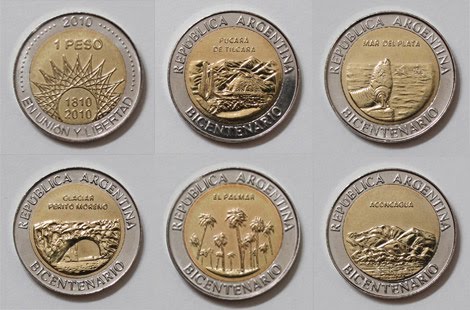
I don’t usually collect anything but as soon as I saw the first one I knew I wanted to have the five of them. And I do! I am talking about the five new one peso Argentinian coins which started circulating a few months ago. The government announced that these commemorative coins were starting to be in circulation in June. As I previously mentioned they are commemorative coins, they are part of the bicentennial celebration of our country.
What is special about them? If you look at them from a distance you would say that there is no difference between them and the ordinary one peso coins. The new coins are bimetal just as the other ones but the difference is that they depict five different popular Argentinian areas:
Pucara de Tilcara: it is located in Jujuy, outside the city of Tilcara and is a famous historical site. The Pucara de Tilcara is the ruins of Inca’s fortifications that were built about 900 years ago. This place was declared a national monument on 2000.
Aconcagua: it is the highest mountain of the world outside Asia. That is to say, it is the highest peak in the Southern and Western hemispheres. Aconcagua is situated in Mendoza and it is 6962 meters of altitude over the level of the sea.
Glaciar Perito Moreno: it is a glacier located in the “Parque Nacional los Glaciares” in Santa Cruz. It is one of the most important tourist attractions in Argentina.
Mar del Plata: as you must all know, it is a famous seaside beach resort in Argentina. It is located in the city of Buenos Aires on the coats of the Atlantic Ocean.
Parque Nacional el Palmar: it is a national park located in my beloved province of Entre Rios. It was created in 1966 for the preservation of the Yatay which is a type of palm tree.
You must have seen one of them. Maybe for you they are just coins, but I find them really nice because of the reason they were launched and because of their depictions: It is more than money, it is a place in your country you should be proud of.

martes, 2 de noviembre de 2010

Wisdom teeth


Four years ago, my four wisdom teeth were removed. We all know that they exist, that most people need to have them removed at a certain point in their lives. But, what are they? Why there is no room in our mouths for them?
Wisdom teeth are the third and final set of molars. They usually appear between the ages of 17 and 21. That is why they are called “wisdom” teeth, since they appear at an age in which we are already young adults. Most of us have the wisdom teeth and, if you are unlucky you may have more than four of them, a case known as supernumerary teeth. In some cases, wisdom teeth may not need to be removed. This is when they are aligned and when there is enough room in the jaw for them to grow in. But, in most cases, there is no room for them and they do not grow properly aligned so they need to be removed.
There are two different theories which attempt to explain this phenomenon of a set of molars for which there is no room in our jaws and that does not grow at a convenient age in our lives. One of these theories claims that in former times, due to the diet, teeth loss was common at an early age. So, wisdom teeth used to grow so as to fill the space left by those teeth that had been lost. They acted as a kind of replacement. The second theory supports the notion that, in the past, human being’s jaws were much larger and as a result they allowed for a larger number of teeth. As our body has developed, nowadays, our jaws are smaller but the number of teeth does not correspond to our actual jaw size. The result is a mouth crammed with teeth that need to be removed as soon as they are visible or tangible.
I do not know about your experience, if you have had your wisdom teeth removed or not, whether you have them or not, or if while reading this you may start thinking that that minor discomfort that you sometimes feel behind your second molars is just your wisdom teeth that are starting to come through. The only thing I know is that lost my wisdom at the dentist’s four years ago!

lunes, 1 de noviembre de 2010

Idioms


An idiom is an expression, word, or phrase that has a figurative meaning that is separate from the literal meaning or definition of the words of which it is made.
It was not until the other day, while I was watching a film (My name is Khan), that I realized the importance of idioms. The protagonist of the film was an autistic person and he was only able to understand the literal meaning of words. So, whenever a person used an idiom or a figurative meaning of a word, this man kept misinterpreting what the other person said. There are so many things that we take for granted an idioms are one of them. That phrase which means this, may be interpreted as something not only completely different but also sometimes ridiculous by a person who gets the meaning of its constituents separately and not as a whole. Here I will write a list of those idioms which in that case could result in total confusion. Just imagine situations in which someone may interpret their literal meaning:

“Out of the frying pan, into the fire”: If you get out of one problem, but find yourself in a worse situation, you are out of the frying pan, into the fire. (Spanish equivalent: “De Guatemala a Guate-peor”)

“Flogging a dead horse”: If someone is trying to convince people to do or feel something without any hope of succeeding, they're flogging a dead horse.

“To kick the bucket”: to die. (Spanish equivalent: inf. “Parar la “pata””)

“Get up on the wrong side of (the) bed” also “wake up on the wrong side of (the) bed” : to begin the day feeling unhappy and uncomfortable. (Spanish equivalent: “Levantarse con el pie izquierdo”)

“To be like a bull in a china shop”: to often drop or break things because you move awkwardly or roughly. (Spanish equivalent: “Como elefante en un bazar”)

" To put your cards on the table": to speak honestly and openly
about your feelings and intentions. (Spanish equivalent:"Poner las cartas sobre la mesa")

" To add fuel to the flames": to say something that makes a
difficult situation worse. (spanish equivalent: "Echar leña al fuego")

My last lesson: an ICT lesson


For our intensive practice period, we, teachers to be, were asked to design and teach an ICT lesson. All of us were well aware of the theory related to the topic: an approach to teaching which involved the introduction of Information and Communication Technologies. This sounded great, and as students we have been part of this type of lesson but now it was our time, and we had to put into practice what we knew about this acronym. This is what the practice period is about, isn’t it?
The name of the unit I was dealing with was “The Media” and we have been working with lots of articles and the passive voice structure so, the most appropriate task to assign was writing an article. The approach to writing was process writing but the question was how to transform an ordinary writing lesson into an ICT writing lesson. Arriving at the answer was not so difficult. The first thing I did was look for an online tool to create newspaper articles. This meant googling “how to create a newspaper article” and the answer was there. I was lucky enough to find a tool which was not only effective but also incredibly easy to use. You just needed to type inside the blank boxes and after a click your article was there, ready to be downloaded and printed. I created a short article myself to be used as model for the writing. This was the most interesting part of my lesson: my students reading a newspaper article which seemed to have been cut out from a real newspaper and the topic of which was how the performance of class 1st A had improved, how their performance in the English class had improved. They found it really funny and their faces showed their astonishment. The lesson went on as an ordinary process writing lesson up to the moment in which I wrote the name of a website on the blackboard and my e-mail address. Students were supposed to create, with what they had written, a newspaper article alike the model they had been working with. They weren’t used to be asked to work with their beloved computer very often. So, they were really excited about it. They created the articles, attached them to an e-mail and send it to me. It was group work so the articles were not many; I created a slideshow with them and sent it to my students. All of us enjoyed the experience. ICT lessons are easier to design than what we think and they are remarkably effective. TOOL

martes, 12 de octubre de 2010

Survival


I had thought about “Survival” as the topic for my presentation but I had never thought that I was going to explore the topic from this point of view: tribal peoples struggling to survive. It was when I googled the word that I found “Survival”, the International Organization for Tribal Peoples, that I started reading and reading and I realized this issue deserved to be dealt with.
The first thing I was shocked by, was the number of indigenous that lives in our planet. About 150 millions across the world and in 60 different countries. Of course this is a minority in relation to the world population but I used to think about indigenous people as a minority of hundreds, never of millions.
Another factor that I found really interesting was that “they” and “we” are affected by the same things: deforestation, pollution. All these things are destroying the places tribal peoples dwell in and as a result, these people are being displaced. But, if we stop to think, that is exactly the same that is happening to our planet, I mean, we live in the same planet and we are all well aware of global warming, pollution, etc and their negative consequences on the biodiversity, soil, environment. Of course, as I mentioned in my presentation everything that is done is done in the mane of progress and is disguised as positive and prosperous.
They are different in the same way you are different from you neighbour: you wear different clothes, listen to different music, have different lifestyles, have different tastes but tribal peoples and you are both human beings, something that goes beyond those differences that I previously mentioned. So, their rights should be respected in the same way your rights should be. It is not fair that they need to be continuously struggling to survive in a world that belongs to them in the same way that it belongs to you. Besides, they were the first to be here, weren’t they?

Here I leave you the link to the Survival webpage. I hope you enjoy it. It is really interesting.

SURVIVAL